How We Made PipKitty: A Hand-Drawn Wasteland Hidden Cats Game
This page shares the art, audio, and engineering notes behind PipKitty, our free single-room wasteland hidden cats game. Rather than repeating the gameplay rules or listing every hiding spot (which you can find in our annotated 16-cat walkthrough), here is how the 2400 × 1350 illustration, ink-locked color masks, and sixteen real feline voices were actually built.
Why Build a One-Room Browser Game Instead of an App?
Many hand-drawn seek-and-find adventures ship as multi-gigabyte desktop or console downloads spanning dozens of stages. When designing PipKitty for fans looking for browser-playable games like A Wasteland Full of Cats, we wanted something a player on a lunch break, laptop, or iPad could open in three seconds with zero installers, zero accounts, and zero clutter—one densely packed desert scrapyard outside Vault 77 where sixteen cats hide across pipes, lockers, tires, and a rusted 1950s cruiser.
Focusing on a single 2400 × 1350 panoramic canvas let us spend our entire budget on linework consistency, smooth 400% pinch-and-wheel zoom physics, and hand-tuned personality details rather than procedural filler levels.
Why Early Cat Stickers Failed—and How Matched 5px Ink Solved It
In our earliest prototype, we drew full-body cat sprites on separate transparent layers and scaled them down behind crates and barrels. On screen, the problem was obvious within seconds: downscaling a high-resolution cat sprite shrank its outlines to thin 1px hairlines, while the surrounding steam pipes, steel gear teeth, and rubber tires had bold 4px–5px dark-sepia pen strokes. Even recolored in sepia, thin-lined cats looked like flat stickers pasted onto the page.
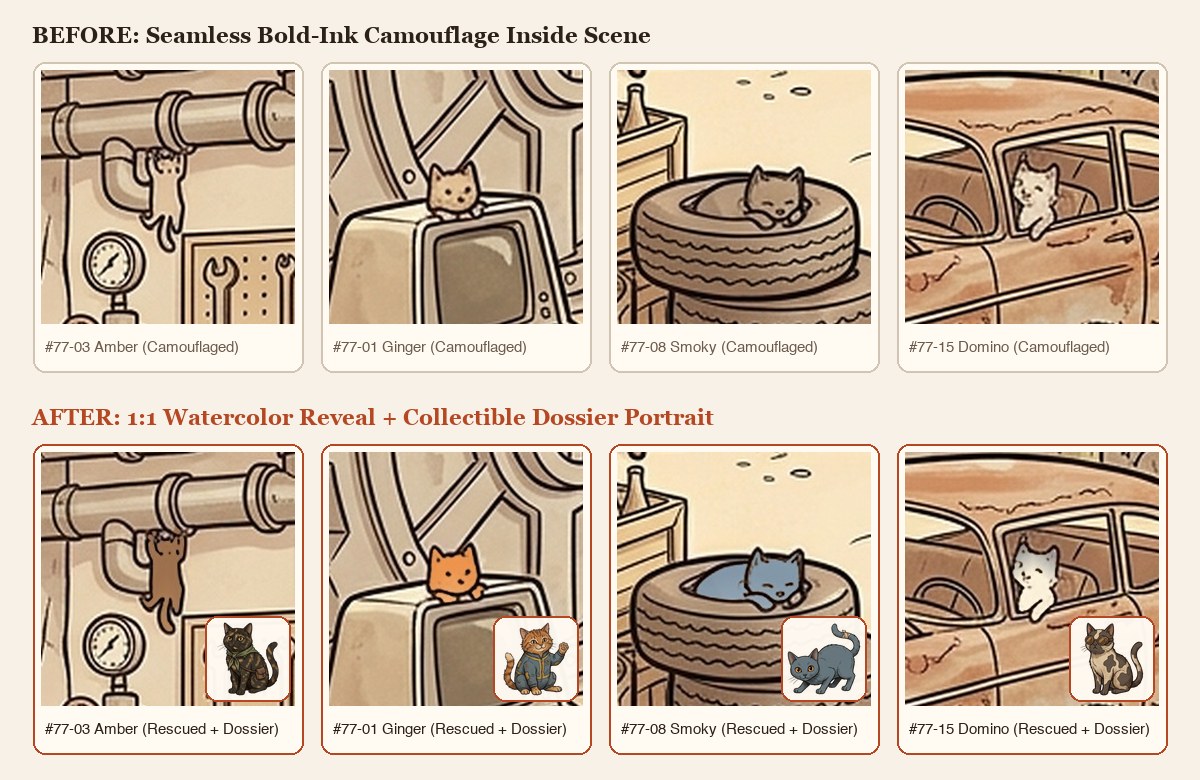
To eliminate that visual mismatch, we rebuilt the artwork pipeline from scratch:
- Native Bold-Ink Integration: Every unfound cat was redrawn directly inside the master
2400 × 1350illustration using the exact same5pxdark-sepia ink brush and warm parchment wash as the neighboring props. When a cat is unfound, the HTML5 canvas draws zero extra sprite layers over the background—so line weight and paper grain match 100%. - Topological Flood-Fill Color Masks: Instead of shifting or scaling a separate sprite when clicked, a Python segmentation script seeds interior points inside each cat's exposed silhouette and flood-fills outward until hitting the inner wall of the
5pxdark ink lines. When you tap a cat in-game, warm watercolor fur wipes in at0.0pxoffset while preserving every pixel of the original dark ink outline.
Why Scene Silhouettes and Compendium Portraits Are Drawn Separately
When a cat is melted flat on a high ceiling pipe or tucked deep inside a half-open locker, only its ears, eyes, or dangling paws are visible on the map. Cropping that tiny map cutout into a collection screen looked cramped and incomplete.
To make collecting rewarding, we illustrated sixteen separate 240 × 240 full-body storybook portraits for the Vault 77 Cat Compendium. Each full-body portrait matches its map counterpart's coat pattern and wasteland prop—from Ginger's patched blue jumpsuit to Sheriff's dented kitchen colander helmet and Domino's round brass welder shades—giving players a complete collectible card whenever a tiny peeking silhouette is found.
Mastering & Denoising 16 Real Cat Meow Recordings
Synthesized retro beeps felt lifeless for a game about rescuing cats, so we curated sixteen real-world domestic cat and kitten vocalizations from Creative Commons environmental audio archives (ESC-50 / Freesound) alongside clean studio replacements.
Raw field recordings often carry room hum, microphone hiss, or clipped peaks. Each of the sixteen audio clips was trimmed to tight onset transients, filtered to remove low-frequency rumble, and loudness-balanced before being encoded for instant Web Audio API playback—pairing deep resonant trills with big shopkeeper tabbies and tiny double mews with pocket-sized shelf kittens.
Ready to test your eyes against the 5px ink linework? Jump straight into the PipKitty wasteland hidden cats game or reach out with feedback on our Contact & Copyright page.